
The Giza Plateau, a timeless testament to human ingenuity, continues to confound and captivate. Its pyramids, particularly the Great Pyramid of Khufu, stand as colossal enigmas, their precise construction methods and purpose shrouded in the mists of antiquity. Recent advancements in sonar technology have peeled back another layer of this ancient mystery, revealing hidden chambers and potential passageways that fuel both scientific inquiry and the more speculative theories surrounding their origins.
The Conventional Narrative vs. Unconventional Hypotheses:
Traditional Egyptology attributes the pyramids to the Old Kingdom pharaohs, built as elaborate tombs and monuments to their divine power. The sheer scale and precision of these structures, erected with rudimentary tools, have long been a source of fascination and debate.
However, alternative theories propose a more complex narrative. The “ancient astronaut” hypothesis suggests extraterrestrial intervention, positing that advanced beings imparted knowledge and technology to the ancient Egyptians. Proponents point to the pyramid’s alignment with cardinal directions, its mathematical ratios (often linked to the golden ratio, ϕ≈1.618), and the seemingly impossible feats of engineering as evidence of non-human involvement.
Another perspective argues for a highly advanced pre-flood civilization, a lost epoch of human brilliance. This theory suggests that the pyramids are remnants of this sophisticated society, built with knowledge and technology lost during a cataclysmic event, possibly the deluge described in various ancient texts.

Sonar Discoveries: Peering into the Unknown:
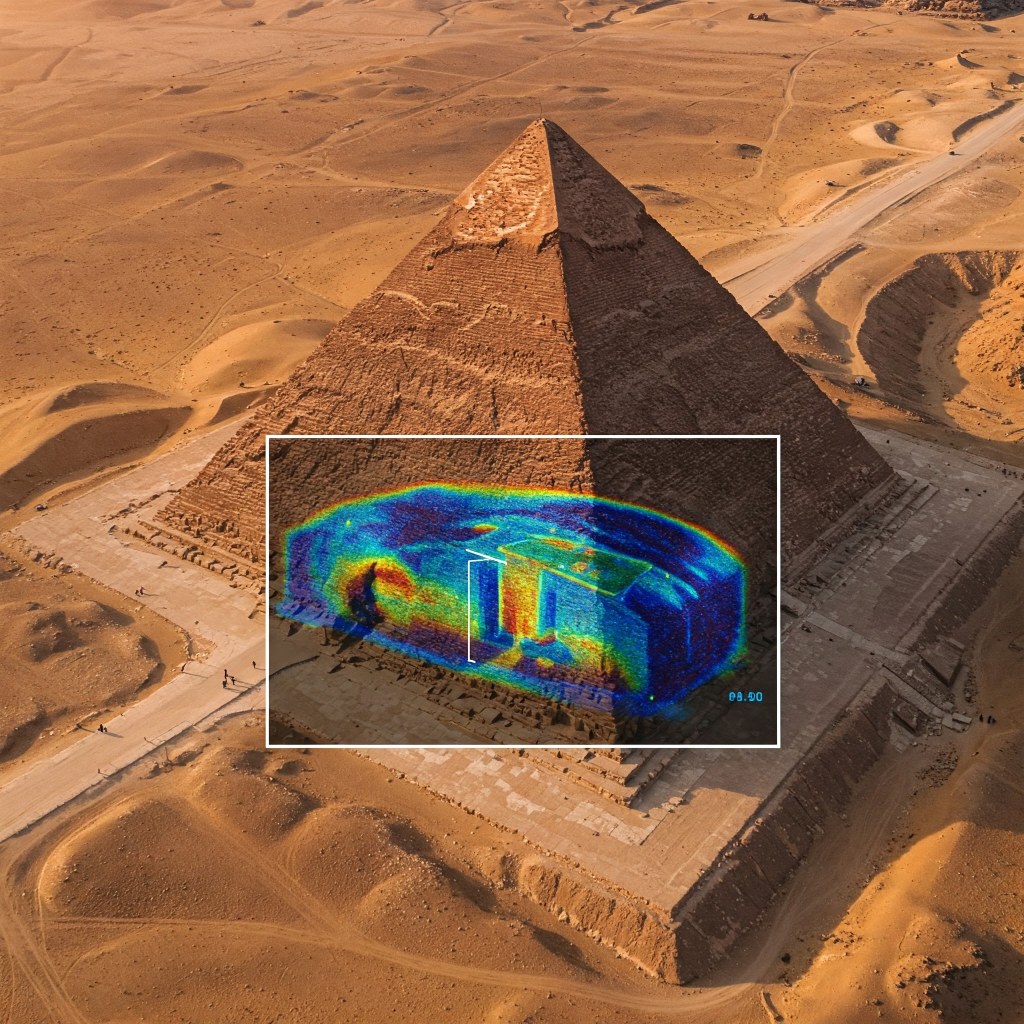
Modern non-invasive techniques, particularly muon radiography and ground-penetrating radar, have revolutionized our understanding of the pyramids’ internal structure. The “ScanPyramids” project, for instance, detected a large void within the Great Pyramid, dubbed the “Big Void.” While its exact purpose remains unknown, it has ignited a flurry of speculation.
Muon Radiography: This technique uses cosmic-ray muons, subatomic particles that penetrate rock, to create 3D images of the pyramid’s interior. Variations in muon density reveal voids and structures hidden within.
Ground-Penetrating Radar: GPR sends electromagnetic pulses into the ground and analyzes the reflected signals to map subsurface features. This method has revealed potential hidden chambers and corridors beneath the plateau’s surface.
Seismic Tomography: This method uses the speed of sound waves through the pyramid to detect internal structures and voids.
These sonar discoveries reveal that the pyramids are far more complex than previously imagined, with hidden chambers and potential passageways that challenge conventional interpretations. The “Big Void,” for example, could be a structural feature, a previously undiscovered burial chamber, or something entirely different.
Vertical Shafts and Descending Channels:
Adding to the growing body of evidence revealed by non-invasive scanning techniques, a team of Italian researchers has presented compelling findings that further deepen the mystery surrounding the Giza pyramids. Their work, utilizing sophisticated ground-penetrating radar and electrical resistivity tomography, has uncovered structures that deviate significantly from conventional interpretations.
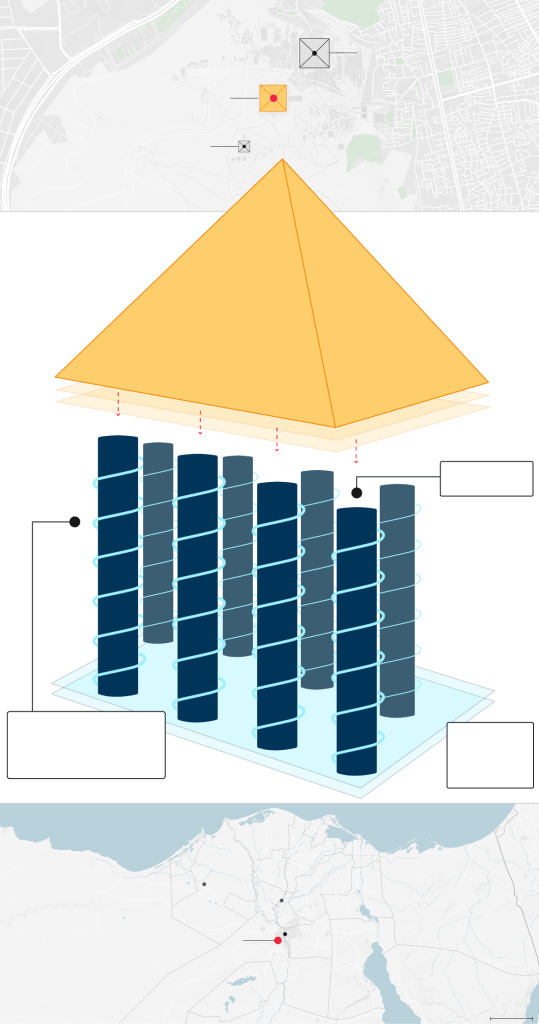
Giant Vertical Shafts with Spiral Staircases:
The researchers reported the discovery of substantial vertical shafts within the bedrock beneath the pyramid complex. These shafts, remarkably, appear to be enclosed by what they describe as “spiral staircases.” This unique architectural feature raises questions about its purpose, as traditional pyramid construction does not typically involve such elaborate vertical structures.
This discovery adds a layer of complexity to the internal architecture of the giza plateau, and could be evidence of a much deeper, older, and more complex set of structures that predate the currently known pyramids.
Massive Limestone Platform with Descending Channels:
Furthermore, the Italian team identified a massive limestone platform beneath the surface, containing two enormous chambers. Within these chambers, they detected descending channels that resemble pipelines. The “pipeline” like structures have caused much speculation. The purpose of these channels is unknown, and the idea that they were used for the transport of liquids, or other materials is being considered.
This discovery is highly unusual and has fueled speculation about the potential use of advanced hydraulic or material transport systems by the builders of the pyramids. If confirmed, this would significantly alter our understanding of the technological capabilities of the ancient Egyptians or any prior civilization that may have constructed the structures.

Implications and Ongoing Debate: These findings, while preliminary, have significant implications for our understanding of the Giza complex.
They raise several crucial questions:
What was the purpose of these vertical shafts and spiral staircases? Were they used for transportation, ventilation, or some other unknown function?
What was the function of the descending channels within the limestone platform? Were they indeed pipelines, and if so, what materials were transported through them?Do these discoveries support the idea of a much older and more technologically advanced civilization that existed before the currently understood Egyptian dynasties?How do these findings fit into the conventional timeline of Egyptian history and pyramid construction?
The Egyptian overseers and the wider archaeological community are approaching these findings with a combination of interest and caution. They emphasize the need for further investigation and independent verification before drawing definitive conclusions.
They stress that: The interpretations of the radar and tomography data must be rigorously tested and validated. Physical exploration, if possible, is essential to confirm the nature and purpose of these structures. The findings must be integrated into the broader archaeological context of the Giza Plateau.
Technical Considerations:
The construction of the pyramids involved sophisticated engineering principles, including: Precise Alignment: The Great Pyramid’s near-perfect alignment with the cardinal directions, with an error of less than 0.05 degrees, suggests advanced surveying techniques. Massive Stone Blocks: The transport and placement of millions of stone blocks, some weighing tens of tons, required a complex logistical system and advanced lifting mechanisms. Internal Passageways: The intricate network of passageways and chambers within the pyramids demonstrates a deep understanding of structural engineering and spatial planning.
The golden ratio: The golden ratio, ϕ=21+5≈1.618, is found in many places within the pyramid. This could be intentional or coincidental.

Conclusion:
The pyramids of Giza remain a testament to the enduring mystery of the past. Sonar discoveries have opened new avenues for exploration, revealing hidden structures that challenge conventional interpretations. While alternative theories offer intriguing possibilities, it is crucial to approach them with a critical and scientific mindset. The ongoing investigation of Giza, combining advanced technology with rigorous archaeological analysis, promises to shed further light on these ancient wonders, revealing more about the ingenuity, and possibly the lost knowlage, of the people who built them.
 Aguilar Productions