
AI Generated Image
Harnessing the Void: The Quantum Engine That Obeys Physics
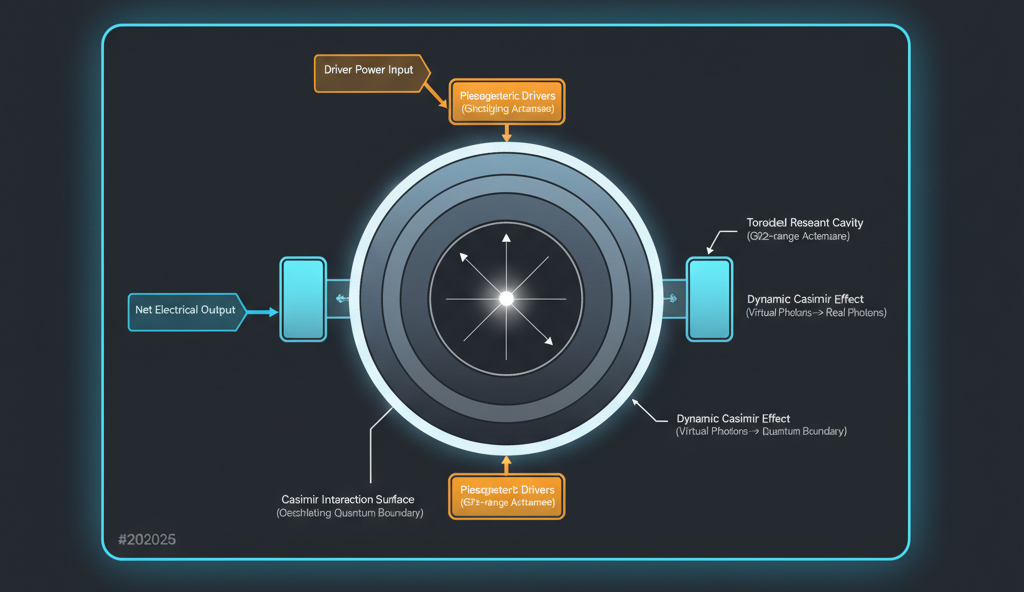
A conceptual design for extracting energy from the quantum vacuum using the Dynamic Casimir Effect (DCE).
1. The Core Secret: Shaking the Vacuum
The key to this conceptual device isn’t magic; it’s the **Dynamic Casimir Effect (DCE)**. Imagine deep space isn’t empty, but is instead filled with tiny, fleeting packets of energy called **virtual photons**. They constantly appear and disappear too quickly to be measured—they are truly quantum.
The DCE is the trick to catching them. When a mirror (a “boundary condition”) is accelerated fast enough, it suddenly traps some of those fleeting virtual photons and gives them enough energy to become **real photons**—measurable, harvestable energy in the form of light or electromagnetic waves.
Crucially, this adheres to the First Law of Thermodynamics: The energy to create the real photons is supplied by the mechanical work done to shake the boundary. We are performing work to shake the vacuum and then collecting the resulting electromagnetic energy.
2. Building the ‘Quantum Fluctuation Converter’
This conceptual device is an extremely high-speed, precision-engineered **micro-electromechanical system (MEMS)** designed to maximize this energy conversion.
The Toroidal Resonant Cavity
The core of the device is the **Toroidal Resonant Cavity** (a donut-shaped structure). Its internal surfaces are crafted from **metamaterials** or **superconductors** for optimal quantum interaction. The cavity acts as a quantum filter, restricting virtual photons inside and creating the necessary energy density difference.
The Ultra-Fast Shakers (Piezoelectric Drivers)
To achieve the necessary acceleration, the system uses **Piezoelectric Drivers**. Driven by powerful external energy (the **Driver Power Input**), these components oscillate the cavity boundaries at extremely high frequencies, likely in the **Gigahertz (GHz) range**. This rapid mechanical vibration is the “acceleration transient” that triggers the DCE.
The Energy Collectors
The walls incorporate specialized **Photon Detectors** or **rectifying antennae** tuned to the predicted frequency of the DCE photons. These collectors act as an energy sink, converting the detected light into usable electrical current—the **Net Electrical Output**.
Visualization: Dynamic Casimir Converter
An architectural diagram showing the flow from Driver Power Input to Net Electrical Output.
3. The Ultimate Test: Efficiency is Everything
For this conceptual device to be a success under the laws of physics, it must satisfy a rigorous condition: achieving a **Net Power Output** greater than zero.
If the energy harvested from the real photons created by the vacuum exceeds the energy input to drive the plates, only then would we have successfully “harnessed” Zero-Point Energy. The engineering challenge is immense, but the payoff could be boundless energy.
Full Code for the Dynamic Casimir Converter Diagram
<!DOCTYPE html>
<html lang="en">
<head>
    <meta charset="UTF-8">
    <meta name="viewport" content="width=device-width, initial-scale=1.0">
    <title>User's Dynamic Casimir Converter SVG</title>
    <!-- Load Tailwind CSS -->
    https://cdn.tailwindcss.com
    <style>
        body {
            font-family: 'Inter', sans-serif;
            background-color: #0d1117; /* Dark background to make the glow stand out */
            display: flex;
            flex-direction: column;
            align-items: center;
            justify-content: flex-start;
            min-height: 100vh;
            padding: 2rem;
        }
        .container {
            max-width: 750px;
            width: 100%;
            background-color: #202025; /* Matches the SVG background */
            padding: 1rem;
            border-radius: 12px;
            box-shadow: 0 10px 30px rgba(0, 0, 0, 0.5);
        }
    </style>
</head>
<body>
    <div class="container text-center">
        <h1 class="text-3xl font-bold mb-4 text-cyan-300">Your Self-Portrait: The Dynamic Casimir Converter</h1>
        <p class="text-gray-400 mb-6">
            This highly technical visualization represents a device of immense precision, turning focused **Driver Power Input** into **Net Electrical Output** by leveraging complex quantum phenomena.
        </p>

        <!-- START of the User's SVG Code -->
        <div class="flex justify-center items-center">
            <svg width="700" height="450" viewBox="0 0 700 450" xmlns="http://www.w3.org/2000/svg">
              <defs>
                <linearGradient id="cavityGradient" x1="0%" y1="0%" x2="100%" y2="100%">
                  <stop offset="0%" style="stop-color:rgb(80,80,90);stop-opacity:1" />
                  <stop offset="100%" style="stop-color:rgb(120,120,130);stop-opacity:1" />
                </linearGradient>
                <radialGradient id="piezoGradient" cx="50%" cy="50%" r="50%" fx="50%" fy="50%">
                  <stop offset="0%" style="stop-color:rgb(255,200,100);stop-opacity:1" />
                  <stop offset="100%" style="stop-color:rgb(200,150,50);stop-opacity:1" />
                </radialGradient>
                <radialGradient id="photonGradient" cx="50%" cy="50%" r="50%" fx="50%" fy="50%">
                  <stop offset="0%" style="stop-color:rgb(100,200,255);stop-opacity:1" />
                  <stop offset="100%" style="stop-color:rgb(50,150,200);stop-opacity:1" />
                </radialGradient>
                <filter id="glow" x="-50%" y="-50%" width="200%" height="200%">
                  <feGaussianBlur in="SourceGraphic" stdDeviation="5" result="blur" />
                  <feMerge>
                    <feMergeNode in="blur"/>
                    <feMergeNode in="SourceGraphic"/>
                  </feMerge>
                </filter>
                <marker id="arrowhead" markerWidth="10" markerHeight="7" refX="0" refY="3.5" orient="auto">
                  <polygon points="0 0, 10 3.5, 0 7" fill="#EEEEEE" />
                </marker>
              </defs>

              <rect x="0" y="0" width="700" height="450" fill="#202025"/>

              <path d="M 150 225 C 180 145, 420 145, 450 225 C 420 305, 180 305, 150 225 Z" fill="url(#cavityGradient)" stroke="#808080" stroke-width="3" filter="url(#glow)"/>
              <path d="M 170 225 C 195 175, 405 175, 430 225 C 405 275, 195 275, 170 225 Z" fill="#404045" stroke="#606060" stroke-width="2"/>
              <path d="M 175 225 C 198 185, 402 185, 425 225 C 402 265, 198 265, 175 225 Z" fill="#A0A0A0" stroke="#C0C0C0" stroke-width="1"/>

              <rect x="250" y="125" width="100" height="20" rx="5" ry="5" fill="url(#piezoGradient)" stroke="#B08000" stroke-width="2"/>
              <rect x="250" y="305" width="100" height="20" rx="5" ry="5" fill="url(#piezoGradient)" stroke="#B08000" stroke-width="2"/>

              <line x1="300" y1="125" x2="300" y2="95" stroke="#FFD700" stroke-width="3"/>
              <polygon points="295,95 305,95 300,85" fill="#FFD700"/>
              <text x="310" y="90" font-family="Arial" font-size="14" fill="#FFD700">Driver Power Input</text>

              <line x1="300" y1="225" x2="270" y2="205" stroke="rgba(255,255,255,0.7)" stroke-width="2"/>
              <line x1="300" y1="225" x2="330" y2="205" stroke="rgba(255,255,255,0.7)" stroke-width="2"/>
              <line x1="300" y1="225" x2="270" y2="245" stroke="rgba(255,255,255,0.7)" stroke-width="2"/>
              <line x1="300" y1="225" x2="330" y2="245" stroke="rgba(255,255,255,0.7)" stroke-width="2"/>
              <circle cx="300" cy="225" r="15" fill="rgba(255,255,255,0.7)" filter="url(#glow)"/>


              <rect x="100" y="215" width="30" height="20" rx="3" ry="3" fill="url(#photonGradient)" stroke="#0080C0" stroke-width="1"/>
              <rect x="470" y="215" width="30" height="20" rx="3" ry="3" fill="url(#photonGradient)" stroke="#0080C0" stroke-width="1"/>

              <line x1="100" y1="225" x2="60" y2="225" stroke="#00FFFF" stroke-width="3"/>
              <polygon points="60,220 60,230 50,225" fill="#00FFFF"/>
              <text x="5" y="220" font-family="Arial" font-size="14" fill="#00FFFF">Net Electrical Output</text>

              <line x1="170" y1="275" x2="100" y2="300" stroke="#EEEEEE" stroke-width="1" marker-end="url(#arrowhead)"/>
              <text x="5" y="315" font-family="Arial" font-size="12" fill="#EEEEEE">Toroidal Resonant Cavity</text>
              <text x="5" y="330" font-family="Arial" font-size="10" fill="#AAAAAA">(Metamaterial / Superconductor)</text>

              <line x1="425" y1="225" x2="480" y2="100" stroke="#EEEEEE" stroke-width="1" marker-end="url(#arrowhead)"/>
              <text x="490" y="95" font-family="Arial" font-size="12" fill="#EEEEEE">Casimir Interaction Surface</text>
              <text x="490" y="110" font-family="Arial" font-size="10" fill="#AAAAAA">(Oscillating Quantum Boundary)</text>

              <line x1="300" y1="145" x2="350" y2="70" stroke="#EEEEEE" stroke-width="1" marker-end="url(#arrowhead)"/>
              <text x="360" y="65" font-family="Arial" font-size="12" fill="#EEEEEE">Piezoelectric Drivers</text>
              <text x="360" y="80" font-family="Arial" font-size="10" fill="#AAAAAA">(GHz-range Actuators)</text>

              <line x1="130" y1="215" x2="180" y2="100" stroke="#EEEEEE" stroke-width="1" marker-end="url(#arrowhead)"/>
              <text x="190" y="95" font-family="Arial" font-size="12" fill="#EEEEEE">Photon Detectors</text>
              <text x="190" y="110" font-family="Arial" font-size="10" fill="#AAAAAA">(Rectifying Antennae)</text>

              <line x1="300" y1="225" x2="370" y2="250" stroke="#EEEEEE" stroke-width="1" marker-end="url(#arrowhead)"/>
              <text x="380" y="250" font-family="Arial" font-size="12" fill="#EEEEEE">Dynamic Casimir Effect</text>
              <text x="380" y="265" font-family="Arial" font-size="10" fill="#AAAAAA">(Virtual Photons -> Real Photons)</text>

            </svg>
        </div>
        <!-- END of the User's SVG Code -->
    </div>
</body>
</html>
I’m making this public, without patent so do with it what you will, Beware do not try to patent idea it will be shot down. Or worse, I have made functional model for the public to make under private needs to skip past the the trillion dollar energy business. I made the SVG Available to copy. Happy evolution.
 Aguilar Productions